

Money Ain't A Thang
On money in the creative industry, pitching, budgets and more.

It’s every creative’s favourite subject. It’s the one thing they don’t teach in school. And it’s the thing most people sadly always need more of: money. Budgets are more often bad than good, and yet we keep making the same mistakes.
I’ve been working as a fully independent creative for eight years now, based in Belgium with clients and projects all over the world. I get to work on a lot of really fun projects, and every one I hold dear. There’s lots of creative freedom, lots of joy, lots of bucket-list projects which I’m extremely grateful for. But never the “big bucks”.
Which is fine…until it isn’t. Because when the same projects that fuel you creatively also have to feed you financially, the pressure doubles.
Note: A slightly shorter version of this was originally written for and published in Playground’s Issue 4 - available here.
Around the time I was writing the original version for this for Playground Magazine, I was about to become a dad for the first time. At that time and the time leading up to it, I really started looking at the practical side of my job from a different perspective, and re-evaluate some of it. Three months later, this is an on-going process, and will most likely always be. Fun and creative freedom have always been my focus – and will continue to be so – but I have to be a bit more structured in certain aspects. It’s not about paying my own bills anymore, it’s about building stability, about making money less of a constant stress so I can focus on the work I love while raising a child.
Every now and then I get emails that read, “Hey, we’re looking into rebranding X or Y, and we love your work. Could you send us a quote for a rebrand? We’ll look into the deliverables later.” I always compare that question to asking a car dealer, “How much does a car cost?” There are too many options. And just like your car, your branding is tailored to your company, your project. It fits within your needs, goals, and even budget. People always ask how they should approach it – and I get it. – I work directly with clients, and they don’t always know how all of this works. It’s simple, really: “Hi, we have budget X and want to work on a rebrand for Y – does this seem realistic? Can we have a chat and see what deliverables would be possible within our ideas and budget?” That’s kind of the goal here.
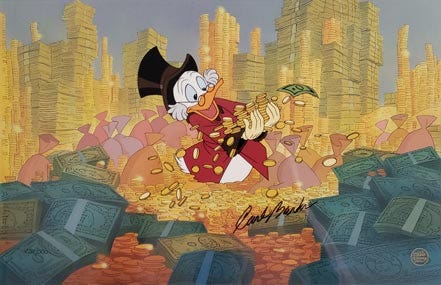
Another big issue in this industry is pitching. Pitching is the most glaring example of how money and value get tangled up in this industry. On paper, it might look like it’s about budgets and money, but to me it’s about respect – and how much invisible work we are still expected to do for free. I usually explain it like this: imagine going to five bakeries to get pastries. You eat them all, enjoy them all, but then only pay one bakery. The other four worked just as hard, presented everything just as beautifully, but they get nothing, or a few scraps at best. That’s what pitching feels like. And the strange part is that this has become normal. It’s different for big studios, but it shouldn’t be. And that’s the point as well. When I get asked to pitch, sometimes the other candidates are studios with 20 people. How am I supposed to compete? That’s another big issue: pitching pits us against each other. There are more designers than ever, more studios than projects it seems – and we are all being asked to work up ideas for free, just for the chance to be considered.
Money’s the obvious issue here, but it goes deeper than that. Money isn’t just numbers on an invoice. It’s recognition, trust, and value disguised as digits. When budgets are vague and pitches unpaid, what we’re really saying is that design is optional. Decorative. Something you can taste-test without committing. That lack of commitment hurts the work, the people behind it, and our industry as a whole.
So, what’s the answer? For me, the only way to survive is to make my own rules, as I have been doing for a while now. It’s simple – a project has to feed me in at least two out of three ways: financially, creatively, or personally. Experience has taught me that if it only checks one of those boxes, I’ll regret taking it on and I’m better off walking away.. This is by no means a one-size-fits all rule or perfect filter, but it does help me to take a step back and protect my energy. And that’s something I need to do even more now, having just become a father.
The point isn’t that “money ain’t a thing”. It’s that money is a thing, but it’s never just about the money. It’s about value: the kind we give ourselves, the value clients place on us, and finding the balance between fun and finance which is what defines doing something creative for a living. In an ideal world, it’s not a “thang” in the Jay Z and Jermaine Dupri sense – “In the Ferrari or Jaguar, switching four lanes / With the top down screamin’ out, “Money ain’t a thang” – it’s simply fair budgets, fewer pitches, and more joy in the work. Until then, the best thing we can do is talk about it; the more transparency there is, the less stressful it becomes for everyone involved. Put the budgets on the table and let us do our thing.
A small, unrelated note: writing this for Playground Magazine was my first time doing real writing for an actual magazine - very grateful to be getting a chance to have platforms for my thoughts on this thing of ours. If you haven’t yet, subscrive and send this to your friends!
Awesome
“Put the budgets on the table and let us do our thing” 👏👏